

Cachalia warns criminal networks are 'competing with the state'
Acting Police Minister Firoz Cachalia has issued a stark warning that organised criminal networks have grown so powerful and deeply embedded in South Africa’s institutions that they now pose a direct threat to the state itself.
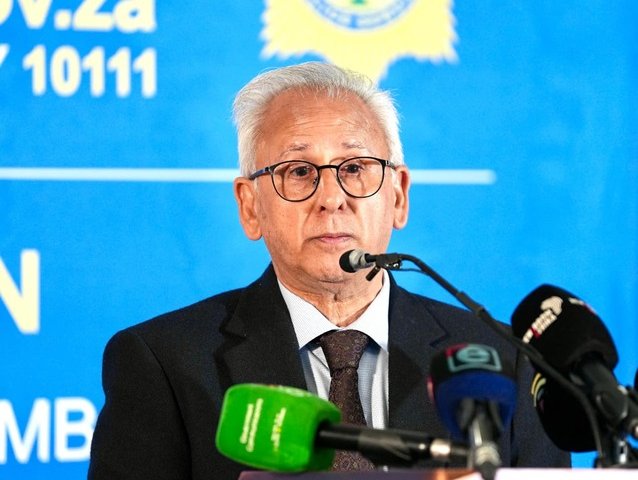
He delivered the warning during his opening address at the release of the 2025/26 quarter one and two crime statistics, describing the moment as a dangerous crossroads for the country.
Cachalia said the newly released crime figures - which cover the period from April to September 2025- show declines in several violent crime categories, but still paint a picture of a society under siege.
"We are at a point where criminal networks are not hiding in the shadows anymore, they are operating in boardrooms, in procurement offices, and in the corridors of power. They are competing with the state."
The acting minister said he wanted to speak directly to the public before the SAPS Crime Registrar, Major General Thulare Sekhukhune, presented the data.
He acknowledged that many South Africans feel failed by the justice system, saying crime victims carry the burden of a state that is not yet strong enough to protect them.
"I know what it feels like to be mugged in the street. I know the fear families live with when violence strikes in their own homes, and too many criminals escape justice. Too many families are left with trauma that no statistic can ever measure."
Organised crime ‘bleeding the country dry’
Much of Cachalia’s address centred on the scale and sophistication of organised crime. He said syndicates have infiltrated political parties, government departments, procurement systems and even parts of SAPS.
"These criminals wear fancy suits and designer clothes, pretending to be legitimate businesspeople, but they are bleeding our country dry."
He pointed to the Madlanga Commission and the Parliamentary Ad Hoc Committee of Inquiry — both probing alleged collusion between criminals, senior police officers and elected political leaders — as critical to exposing the networks undermining state institutions.
"What we are seeing is a continuation of state capture in different forms, citing the Gauteng Health Department’s multi-million-rand fraud case as an example of organised criminality outside conventional crime categories."
Cachalia said dismantling these networks must become a national priority.
"We must follow the money and hit the criminals where it hurts, we need fast, effective prosecutions and strong witness protection. Without that, the criminals win."
‘Policing collapses when loyalty to a faction replaces loyalty to the Constitution’
He delivered an unflinching critique of political interference and corruption within the SAPS, stating that it has eroded public trust and enabled criminal networks to flourish.
"Policing collapses when loyalty to a faction becomes more important than loyalty to the Constitution; the people steering the SAPS must have unquestionable integrity."
While emphasising that only a small group of senior officers are implicated in wrongdoing, Cachalia said the consequences have been devastating for the majority of honest officers.
He praised those who resist corruption, highlighting the example of a Directorate for Priority Crime Investigation (Hawks) officer who refused a R100,000 bribe linked to the Tembisa Hospital corruption case.
"He set up a sting operation and ensured the arrest of his corrupt colleague; that is the kind of courage we need."
The Acting Minister also expressed concern over the number of police officers killed during the reporting period.
"Forty-one SAPS members were killed in these six months, and 35 of them were off duty; it shows the level of danger our members face even when they are not in uniform."
Prevention must match enforcement
Cachalia urged the country to shift from a crisis-response approach to a sustained prevention-driven model, led by the Integrated Crime and Violence Prevention Strategy.
She said tackling root causes — such as youth unemployment, drug addiction, alcohol abuse, and urban decay — is essential if violent crime is to be reduced in the long term.
"Our approach cannot rely only on arrests and prosecutions. These alone will not create lasting safety; we need a whole-of-government and whole-of-society response."
The Acting Minister highlighted gender-based violence, illegal firearms and alcohol accessibility as three critical pressure points.
He said the link between alcohol and violence is “undeniable” and confirmed he will be engaging provinces on stricter liquor regulation.
Cachalia also revealed that R40 million had recently been allocated to strengthen victim-empowerment services.
Mixed trends in crime figures
Although South Africa recorded a significant drop in some serious violent crimes, Cachalia said the overall levels remain far too high.
"We are beginning to see meaningful reductions in murder and aggravated robbery, but the truth is that our country is still deeply unsafe."
Sexual offences and gender-based violence remain stubbornly high, while commercial crime — increasingly occurring online — continues its five-year upward trajectory.
A call to action
Cachalia made a direct appeal to communities, political leaders, civil society and the private sector: "Further progress is possible — but only if we work together, join your local CPF. Join a block-watch. Create safe spaces for young people. Hold us accountable. Demand better."
He said the release of the crime statistics should not be treated as a technical exercise, but rather as a reminder of what is at stake.
"These numbers represent real pain, real trauma and real people. A safer, more just South Africa is possible — but only if we confront the reality with honesty and determination."
ALSO READ
