

Defence committee says SANDF deployment in Johannesburg is lawful
The chairperson of Parliament’s Portfolio Committee on Defence and Military Veterans says the deployment of soldiers to parts of Johannesburg affected by gang violence and illegal mining is fully supported by the law.
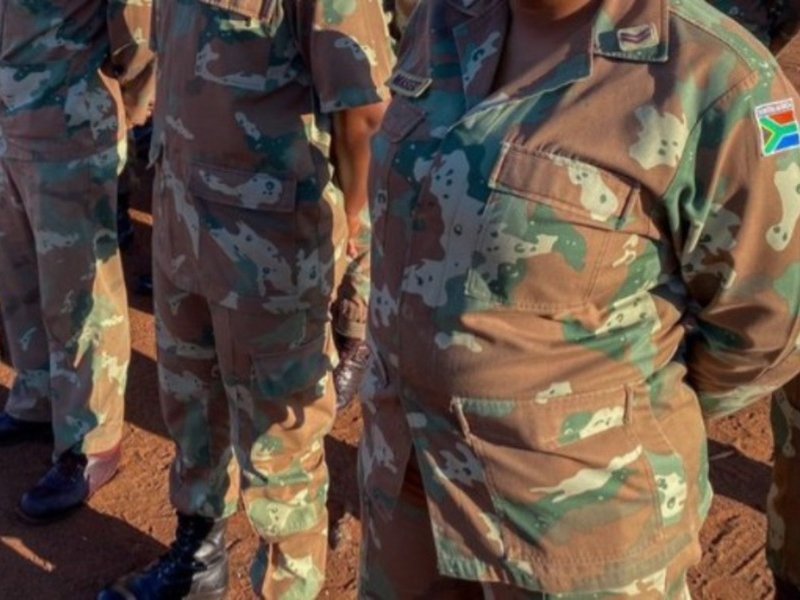
Dakota Legoete affirmed this legality in an SABC interview after members of the South African National Defence Force (SANDF) were deployed to affected areas of Johannesburg.
Soldiers patrolled the Westbury and Riverlea areas on Wednesday in a broader operation against illegal mining and organised crime in Gauteng.
This intervention is a national initiative, announced by President Cyril Ramaphosa, to support the South African Police Service (SAPS) in targeting criminal networks involved in illegal mining and gang violence.
Legoete dismissed concerns about the legality of the deployment, saying the Constitution clearly empowers the president to deploy the military in support of the police.
"The deployment of the National Defence Force is fully explained at the end of the Constitution, Section 201, read with subsection 2, which clearly gives the prerogative to the President of the Republic to deploy the South African National Defence Force with the police."
He added that the law also requires the president to inform Parliament of the details of the operation.
"Subsection 3 clearly defines what needs to be done when the President undertakes that deployment. He must furnish Parliament with the reasons for the deployment, the location, the number of personnel involved, as well as the costs of that particular operation."
Legoete said the same provisions are also contained in the South African National Defence Act, which outlines the procedures that must be followed when the military is deployed within the country’s borders.
He also noted that the Constitution allows the President to report to Parliament after the deployment if the National Assembly is not sitting at the time.
"Section 201, subsection 4 says that if there was no sitting of the National Assembly, the president has seven days after the deployment to report to the Committee of Defence, which constitutes both houses of Parliament."
Legoete said the report is expected to be submitted either to the Speaker of the National Assembly or the chairperson of the National Council of Provinces.
Legoete also criticised what he described as attempts to create confusion around the deployment.
"There is no need to cast suspicions or create confusion. The law is very clear in terms of the processes, and as a responsible Portfolio Committee, we will deal with the matter once the communication from the president reaches Parliament."
The joint deployment of police and soldiers is intended to disrupt and dismantle organised crime networks linked to illegal mining in Gauteng.
More than 500 soldiers have reportedly been deployed as part of the operation, which is expected to run until March 2027 and could cost more than R80 million.
ALSO READ
