

Govt ramps up battery storage as Ramokgopa unveils new power procurement plan
Electricity and Energy Minister Kgosientsho Ramokgopa has said that government is moving to significantly expand battery energy storage as part of a new electricity generation programme aimed at protecting the stability of the national grid.
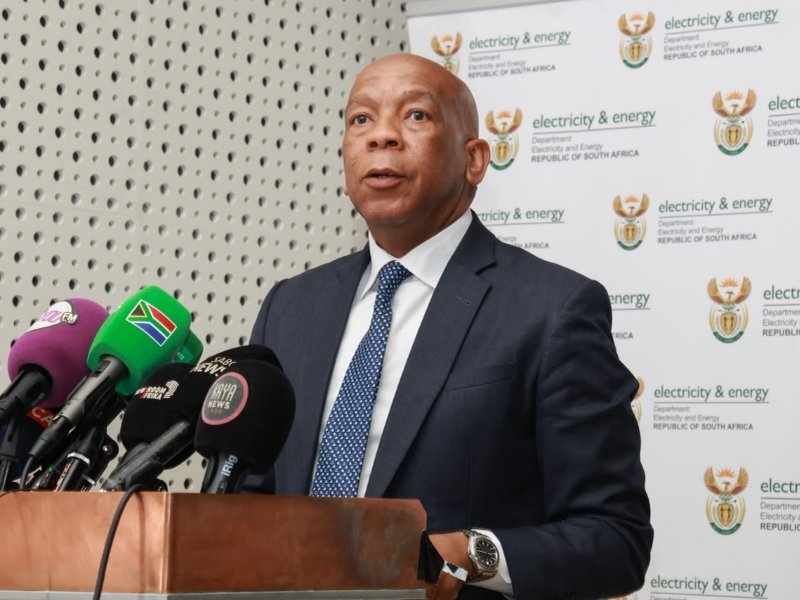
On Wednesday, Ramokgopa announced a new Section 34 Determination for significant additional generation capacity over the 2026 to 2037 planning horizon.
The determination includes wind, solar, battery energy storage and gas-to-power technologies.
The minister said government was ramping up planned battery storage because the electricity system is already dealing with excess generation, particularly as more renewable energy comes onto the grid.
He said the problem needs to be addressed before it develops into another electricity crisis.
"We're ramping that up to 4,600 because the problem is now. The system operator does make the point, but if it continues unabated, and with our projection of new generation that will come on stream from renewable, the system operator is going to sit with the crisis and that's why we have to move now."
Ramokgopa said government is effectively front-loading battery storage to absorb excess electricity when it is available and make it available to the system when required.
-Looking ahead-
The minister said the country needs to address both its immediate electricity challenges and its future energy requirements.
"We are addressing a now problem and also a future problem, if we don't address it now, we're likely going to revert back to a situation of crisis and that's why planning is important."
He said the government does not want to lose the gains made in stabilising the electricity system.
The new procurement programme is also intended to support economic growth and industrialisation, with government seeking greater participation from South African companies and local communities.
Ramokgopa added that the energy build programme must create productive capacity in the local economy rather than simply relying on imported equipment.
"A sequence pipeline will enable South African firms to invest in productive capacity. Localization obligations must distinguish domestic manufacturing from imported equipment and local assembly with measurable commitment and verified delivery."
He said the Independent Power Producer Office, working with the Department of Trade, Industry and Competition, will determine how local participation can be strengthened.
Ramokgopa said government will also develop power parks where electricity generation can be located closer to industrial demand.
"The second unique feature of these power parks that we'll be announcing is that we'll be co-locating loads. So instead of relying on a transmission infrastructure, we are able to match the load to the power parks."
Ramokgopa explained that more details on the power parks are expected before the end of the year.
-Affordability and load reduction-
The minister also addressed the issue of electricity affordability, saying South Africa faces a contradiction where there can be excess generation capacity while some households remain without electricity because they cannot afford to buy electricity units.
He said government is reviewing the country's electricity pricing policy and is exploring ways to use excess daytime generation to benefit consumers and industry.
"I'm talking about excess generating electricity, but the households now, as I speak to you, have no electricity because they just can't afford to buy the units. So it's a contradiction in terms. Excess, but yet people don't have electricity."
According to the minister, government will address this through the electricity pricing policy and other measures to make better use of excess generation capacity.
On local electricity constraints, the minister said load reduction has been eliminated in seven of the country's nine provinces, with Gauteng and KwaZulu-Natal still facing challenges.
He attributed the remaining problems largely to local infrastructure constraints, increased electricity demand, illegal connections and the growth of informal settlements.
"We have eliminated load reduction in seven of the nine provinces. We are left with the two provinces of Gauteng and KZN and we are working at pace to resolve that problem."
Ramokgopa said government will work with municipalities to forecast future electricity demand and invest in infrastructure capable of supporting that growth.
The minister also confirmed that government is considering proposals for Bitcoin mining operations to absorb some of the country's excess electricity.
He says discussions have already taken place involving the ministry, Eskom and industry players.
"We are sold on its technical claims. We can confirm that indeed it provides a unique solution for our situation and in fact, it brings significant amount of value into the South African energy sector."
Ramokgopa explained that the proposal could potentially see between one and three gigawatts of electricity being used by Bitcoin mining operations over the next two years.
ALSO READ
