

Madlanga Commission: Adams traces Khumalo case to Crime Intelligence ‘political battles’
Suspended NCC MP Fadiel Adams has told the Madlanga Commission that Crime Intelligence is a “festering open wound”, alleging political interference, patronage and misuse of intelligence resources while calling for a complete overhaul.
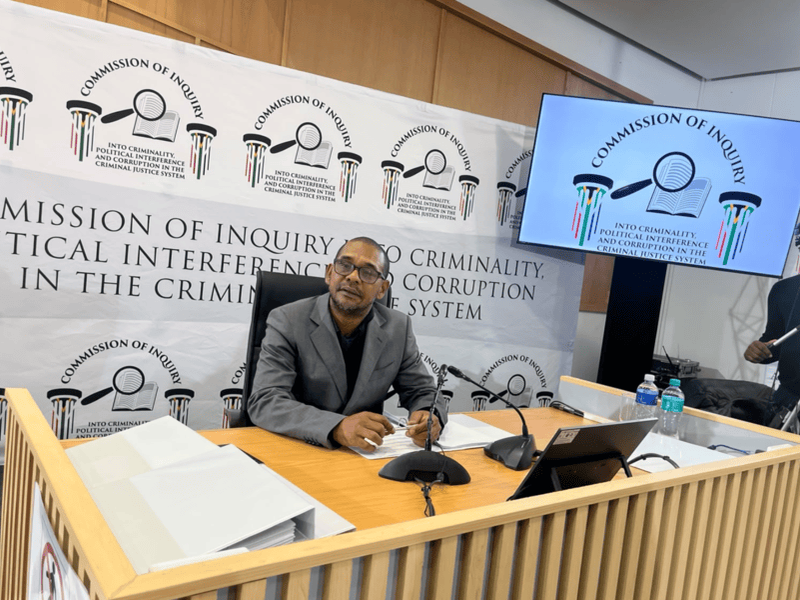
Suspended National Coloured Congress MP Fadiel Adams has described Crime Intelligence as a “festering open wound”, accusing the division of being used for political battles, patronage and the alleged misuse of intelligence resources.
Adams gave evidence at the Madlanga Commission of Inquiry on Wednesday about his report to the Investigating Directorate Against Corruption (IDAC), which implicated senior Crime Intelligence officers in wrongdoing.
In 2024, Adams opened six criminal cases against Crime Intelligence head Dumisani Khumalo and his colleagues, accusing them of misconduct based on reports he said had been supplied by whistleblowers.
However, the commission has heard evidence that Adams was untruthful about the alleged report's existence and that the cases may have been engineered by IDAC.
The circumstances surrounding the cases and Adams’ role in the process are among the issues the commission is examining.
In his statement before the commission, Adams gave a much broader account of how he alleges his concerns about Crime Intelligence developed.
He said Crime Intelligence is “at the heart of the fight against crime” and is “the pulse of policing in relation to crime prevention and detection”.
“A malfunctioning Crime Intelligence unit has extremely far-reaching consequences for the fight against crime,” Adams said.
He claimed that since around 2000, Crime Intelligence had been used for “political battles, patronage and the maladministration of slush funds”.
Adams told the commission he believes these practices were “perfected during the period associated with (former Crime Intelligence head) Richard Mdluli”.
ALSO READ: Fadiel Adams arrested after failing to report to police
He further claimed that the division operated on a “nepotistic basis”, involving “jobs for friends and family”, and at times functioned “more like a glorified employment agency”.
Adams said numerous reports have previously been commissioned into Crime Intelligence and its weaknesses, but believes “insufficient action was taken to eradicate the problems that had developed”.
He believes the division “requires a complete overhaul”, together with “a structured approach to the execution of its mandate”.
'FESTERING OPEN WOUND'
Adams alleged that his concerns did not arise from one incident.
“The matters described herein did not arise from a single event,” he said.
“Rather, they developed progressively over a period of time through complaints received by me, documentation that came into my possession, my engagement with oversight institutions and my interactions with members of law enforcement.”
He said his interest in Crime Intelligence developed while carrying out his public duties as a councillor and later as an MP.
During that period, Adams explained that he increasingly encountered allegations suggesting intelligence structures were becoming relevant to complaints involving “organised crime, policing, political interference and the administration of criminal investigations”.
It was against this background that he came to regard Crime Intelligence as “a festering open wound”.
Adams said the division had “continued to attract undesirable and, in some instances, criminal activities since approximately the year 2000”.
He also questioned the circumstances surrounding the selection of successive heads of Crime Intelligence, saying these raised concerns about “political influence and accountability”.
According to Adams, the division’s budget also increased “disproportionately compared with other internal policing divisions/units”.
He claimed Crime Intelligence was “not always utilised primarily for intelligence gathering”, but was at times used for “personal gratification, patronage and employment of friends and associates”.
CONCERNS ABOUT DUMISANI KHUMALO
Adams specifically raised concerns about the current head of Crime Intelligence, Dumisani Khumalo.
“Unfortunately, it appears to me that Lieutenant General Khumalo has followed in the footsteps of former leadership within Crime Intelligence,” he said.
His concerns about Khumalo form part of the broader account that Adams has now placed before the commission.
But his evidence must be considered alongside the Commission’s earlier examination of the criminal cases opened against Khumalo and other Crime Intelligence officials, including questions about the alleged report Adams relied on and the role played by IDAC in the matter.
Adams said he initially lacked sufficient information to determine whether all the allegations he encountered were well-founded.
His response, he told the commission, was not to make public accusations.
“My approach was therefore not to make public findings or conclusions, but to seek further information, preserve relevant documentation and refer matters to the authorities responsible for investigating them.”
He said that as additional information became available, he observed “recurring references to officials within Crime Intelligence, the administration of intelligence resources, security clearances, intelligence oversight and the interaction between intelligence structures and criminal investigations”.
“These recurring themes, rather than any preconceived belief, caused me to examine the matters more closely,” Adams said.
He added that information received from third parties was, where reasonably possible, assessed according to its source and whether it could be independently confirmed.
“I attempted, wherever reasonably possible, to identify the source of that information and distinguish between verified facts, allegations requiring investigation and matters that could not be independently confirmed,” he said
Adams told the commissioners that some of the concerns he raised were subsequently referred to or considered by oversight institutions, including the Inspector-General of Intelligence and other competent authorities.
He stressed, however, that such referrals do not prove that the allegations were correct.
“I do not suggest that the existence of such referrals establishes the correctness of the allegations,” he said.
ALSO READ: Suspended MP Fadiel Adams accuses Parliament of defamation
Instead, he said the referrals demonstrate that the matters were “sufficiently serious to warrant engagement by institutions responsible for intelligence oversight”.
Adams said his evidence is ultimately about establishing “the chronology of events, the information available to me at the relevant times, the steps that I took in response to that information and the documentary record that supports those actions”.
“The ultimate findings in relation to Crime Intelligence, its officials or any related institution remain matters exclusively for the commission,” he said.
