

Ramaphosa explains delay in Madlanga report release, updates Parliament SANDF deployment
President Cyril Ramaphosa says the decision not to make the interim report of the Madlanga Commission public was taken to protect witnesses and individuals whose cases are still under investigation.
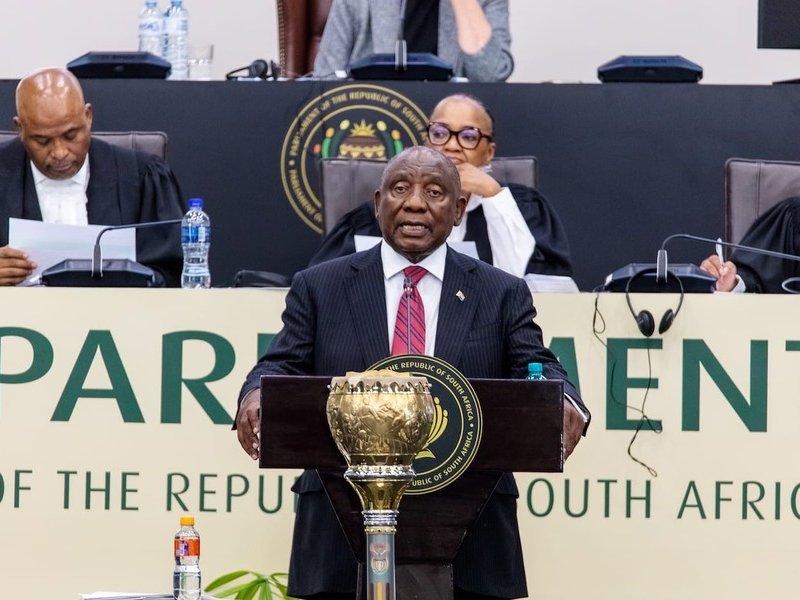
Speaking in the National Assembly on Thursday while responding to questions from MP, Ramaphosa explained that the report contains sensitive information and that the commission’s work is not yet complete.
Criminal Justice Inquiry Report
Ramaphosa said he received the commission’s interim report in December and that it already contains recommendations based on evidence gathered so far.
“The establishment of the Commission of Inquiry into Criminality, Political Interference, Corruption, and corruption into the criminal justice system is indeed a matter of public interest,” he said, adding that the report included recommendations “with respect to matters where there exists prima facie evidence of wrongdoing.”
Although some disciplinary actions have already begun within certain departments, the president warned that releasing the report prematurely could affect ongoing processes.
“Beyond the referrals and recommendations that I have made public, it would be unfair to witnesses whose testimony is not complete or individuals against whom the Commission has not yet made any findings to publicize the information at this stage,” he said.
Ramaphosa also raised concerns about the safety of witnesses, noting that some individuals who appeared before the commission have already faced threats.
“Given the short time frame in which the commission is expected to complete its work, we will make sure, and in fact I will make all the reports public once the Commission has submitted their final report,” he said.
Preparations for National Health Insurance
The president also updated Parliament on the progress being made toward implementing the National Health Insurance (NHI).
He said the Department of Health has been carrying out a range of preparations since the NHI Act was adopted.
These preparations include developing systems to register patients who will use the NHI and establishing frameworks for accrediting and contracting healthcare providers. Digital systems are also being introduced to allow patient records to move easily between different healthcare facilities.
“Since the ascent of the National Health Insurance Act the Department of Health has been busy with a whole range of preparatory work initiatives,” Ramaphosa said.
“This includes procedures for the registration of people who are going to use the NHI and the accreditation framework and the contracting arrangements for healthcare establishments and providers.”
Ramaphosa also confirmed that the government has agreed not to implement certain sections of the NHI Act until the Constitutional Court rules on a legal challenge expected to be heard in May 2026. The case focuses on concerns raised about the level of public participation during the legislative process.
He said this undertaking, which has been made an order of court, will not stop the ongoing preparations for the NHI rollout.
During the session, EFF leader Julius Malema questioned whether the government could introduce 24-hour clinics while longer-term health reforms are still being developed.
"Now that President, you have been exposed to this and especially George Mukari and many other facilities, Chilidzini and everywhere else, are you going to support a proposal of the EFF that says let the clinics be opened 24 hours, let the clinics be serviced and renovated and improved while we are still working on this long term?" Malema asked.
Ramaphosa pointed out that funding remains a key challenge.
He noted that the Minister of Finance previously explained that government has struggled to hire enough doctors to run clinics around the clock. He added that expanding clinic hours would also require proper regulations and guidelines from the Department of Health.
Army Deployed to Support Police
The president also addressed the deployment of the South African National Defence Force to support the South African Police Service in combating crime and illegal mining.
The first group of soldiers was deployed in Sophiatown and other areas west of Johannesburg on Wednesday.
Ramaphosa said the decision aims to strengthen police operations against dangerous criminal networks.
“The SANDF deployment is necessary to complement the efforts of SAPS in tackling these crimes and bringing stability to communities,” he said.
He emphasised that the military will operate under police command and within clearly defined limits.
“The SANDF will be deployed in support of the SAPS, operating under police command, with clear rules of engagement and for specific time-limited objectives,” he said.
According to the president, soldiers may assist with high-risk operations and cordon-and-search missions targeting heavily armed criminals.
"The SANDF may, for example, be called on by the police to provide protection in high-risk operations, or to support cordon-and-search operations against armed criminals,” Ramaphosa said.
The deployment forms part of a broader strategy to fight organised crime, including strengthened anti-gang units and specialised task teams aimed at tackling illegal mining networks.
ALSO READ
